Blog
Notes on the things that broke, and what fixed them.
Subscribe via RSSLetting Strangers Trigger a Gas Leak: Safely Opening a Control Room to the Public - Part 5
Part 5 of HazShield AI. I put a "run a simulation" button on a public control room and had to solve the real problem behind it: how do you let anyone trigger an expensive, resource-hungry plume without letting them take the whole system down?
A Window Into the Plant: Watching a Gas Leak Unfold in Real Time - Part 4
Part 4 of HazShield AI. Three phases of backend work lived in journals and SQL queries. This one builds the control room: a live wall where you watch a methane plume bloom across the plant, and read the machine's isolation plan seconds after it writes it.
My Safety System Wrote Its First Emergency Plan. It Blamed the Wrong Hazard. - Part 3
Part 3 of HazShield AI: an async worker cluster folds thousands of alarms into incidents, hands hazard context to a local LLM, and learns the hard way that a model can write perfect JSON and still misdiagnose a methane leak.
9,964 Readings a Second. Then I Pulled the Plug. HazShield AI — Part 2
Ten thousand sensor readings a second into a Rust gateway capped at 512MB — then I killed Postgres mid-cascade during a simulated gas leak. Zero alarms lost, counted rather than assumed.
I Built a Private Cloud That Runs an AI Safety System Under My Desk - Part 1
A distributed industrial safety system running on one mini PC under my desk - OpenStack squeezed into 28GB of RAM, five public domains with zero open ports, and a database built to survive the firehose.
From Click-Ops to Code: Managing My Self-Hosted OpenStack Cloud with Terraform
Turning a hand-built OpenStack tenant into reproducible Infrastructure as Code — and the service-catalog wall that makes connecting Terraform to a self-hosted cloud harder than the docs suggest.
Building a Self-Hosted OpenStack Private Cloud on a Mini PC (Behind CGNAT, No Public IP)
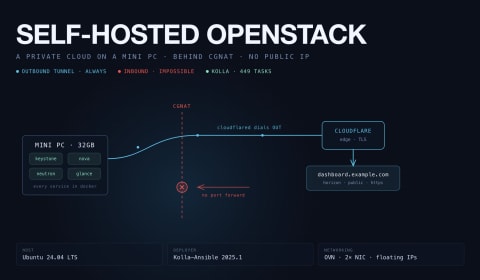
An end-to-end build log: a bare GMKtec mini PC to a public-facing OpenStack cloud you can SSH into, with no public IP and no port forwarding — including every wall I hit and how I got past it.